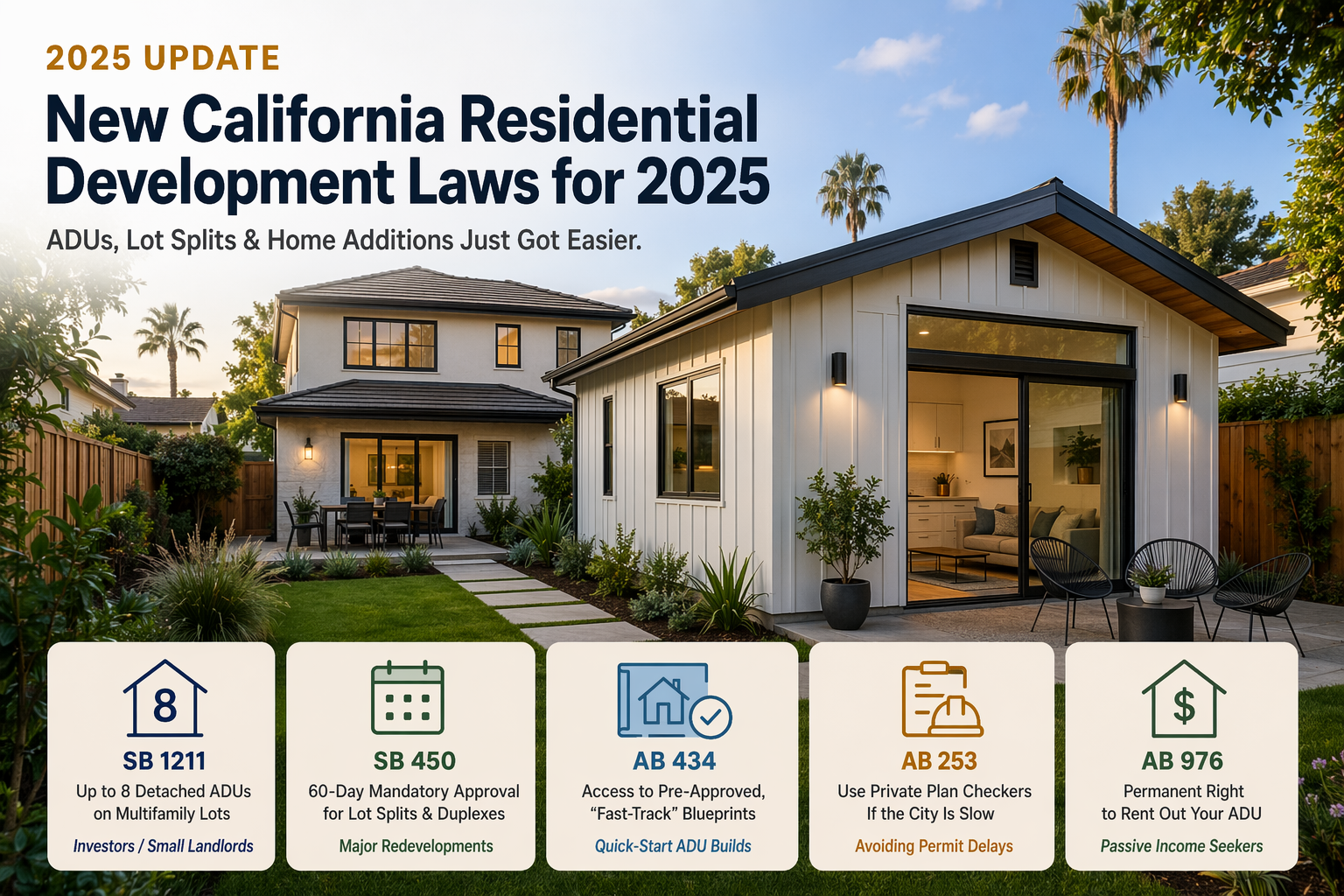
California has recently undergone a major shift in housing policy, with 2025 serving as a landmark year for homeowners looking to maximize their property’s potential. The state has moved aggressively to strip away the “red tape” that historically made ADUs (Accessory Dwelling Units) and home additions a bureaucratic headache.
Here is a breakdown of the most significant legislation enacted or taking full effect in 2025 that directly benefits property owners.
1. Expanding ADU Potential (SB 1211 & AB 976)
While ADUs have been popular for years, the 2025 updates focus on scale and permanence.
- Multifamily Scaling: Under SB 1211, owners of multifamily properties (like duplexes or small apartment buildings) can now build up to eight detached ADUs on their lot, provided they meet setback and height requirements. This is a massive jump from the previous limit of two.
- Ending Owner-Occupancy Mandates: AB 976 made the prohibition on “owner-occupancy” requirements permanent. Previously, some local governments could require a homeowner to live on-site to rent out an ADU. This is now banned indefinitely, protecting the ADU as a pure long-term investment asset.
- Pre-Approved Plans: As of January 1, 2025, AB 434 requires all California cities to have a “pre-approved” ADU plan program. This allows you to select a design that the city has already vetted, drastically shortening the time from application to “shovels in the ground.”
2. Strengthening “Missing Middle” Housing (SB 450)
If you are looking to do more than just an ADU—such as splitting your lot or building a duplex—SB 450 is your most important ally. It was designed to fix loopholes that cities used to block SB 9 (the law that ended single-family-only zoning).
- The 60-Day Clock: Local agencies must now approve or deny an application within 60 days. If they don’t respond, the application is “deemed approved.”
- Reasonable Denials: If a city denies your project, they can no longer give vague reasons. They must provide a specific list of what is “deficient” and exactly how you can fix it.
- Objective Standards: Cities can no longer impose “subjective” design hurdles (like “doesn’t fit the neighborhood vibe”) to kill your project.
3. The “Coastal Zone” Breakthrough (AB 462)
For years, homeowners in California’s Coastal Zones faced a double layer of bureaucracy: local building departments and the California Coastal Commission.
- AB 462 (enacted in late 2025) specifically targets these high-cost areas by expediting the development of ADUs in the Coastal Zone. It streamlines the environmental and permitting hurdles that previously made backyard cottages in beach communities nearly impossible to permit.
4. Faster Plan Checks (AB 253)
Perhaps the most practical “win” for a homeowner in the middle of a remodel is AB 253.
- Third-Party Review: If your local building department is backed up and takes longer than 30 days to review your plans, this law empowers you to use licensed third-party professionals to perform the plan check instead. This prevents your project from sitting in a government inbox for months.
Summary Table for Property Owners
| Law | Key Benefit | Best For… |
| SB 1211 | Up to 8 detached ADUs on multifamily lots. | Investors / Small Landlords |
| SB 450 | 60-day mandatory approval for lot splits/duplexes. | Major redevelopments |
| AB 434 | Access to pre-approved, “fast-track” blueprints. | Quick-start ADU builds |
| AB 253 | Allows private plan checkers if the city is slow. | Avoiding permit delays |
| AB 976 | Permanent right to rent out your ADU. | Passive income seekers |