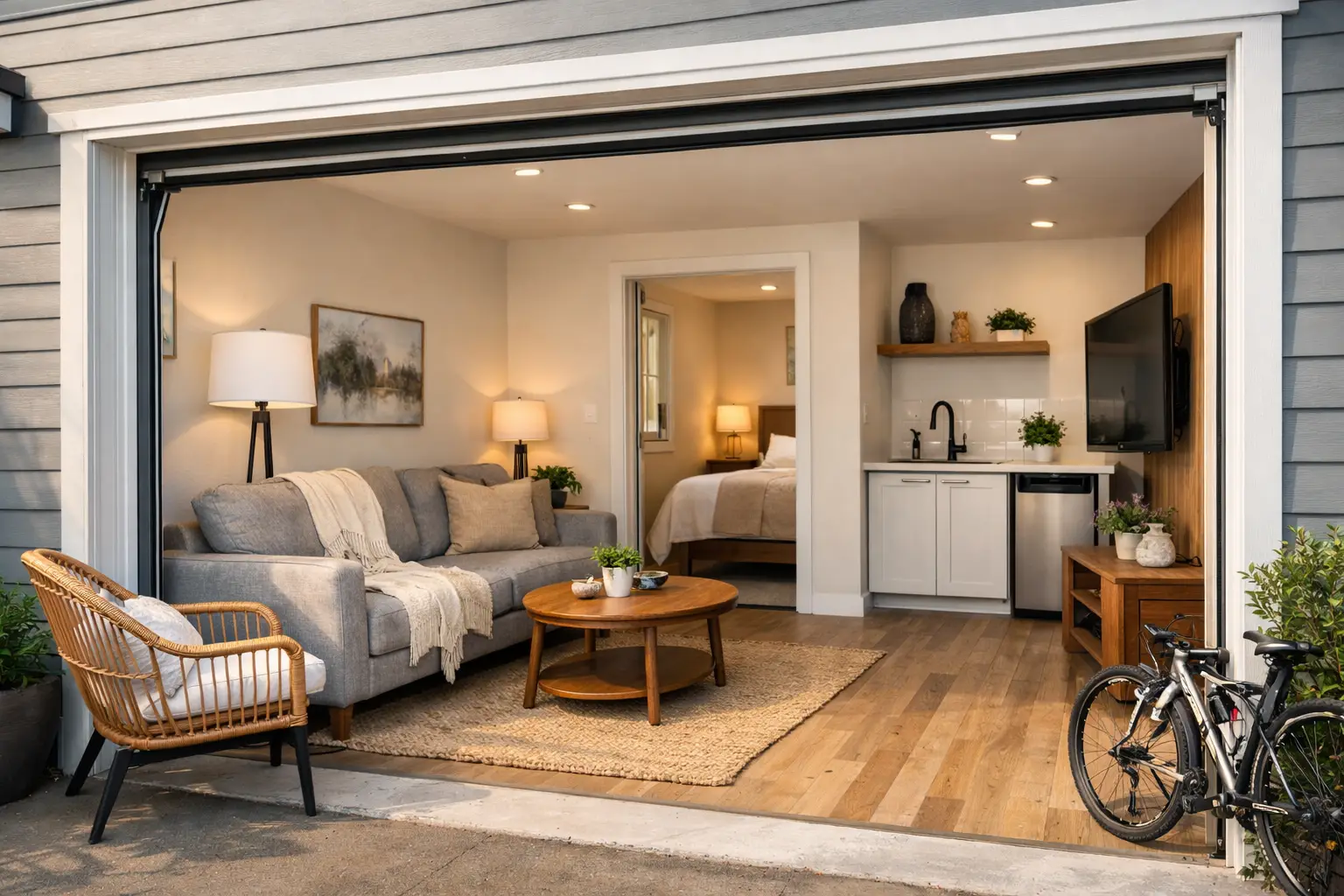
That two-car garage often becomes expensive storage long before anyone admits it. If you need a home office, guest suite, rental unit, or a bedroom for family, garage conversions to living space can be one of the most practical ways to add usable square footage without pushing outward into the yard.
The appeal is obvious. The structure is already there, the roof is already built, and the project can cost less than a full addition. But this is also where many homeowners get surprised. A garage was not built to the same standards as habitable space, so the real work is not just putting up drywall and flooring. It is bringing the space into compliance with structural, energy, ventilation, electrical, and life-safety requirements so it can be legally used as living area.
Why garage conversions to living space make sense
A well-planned conversion can solve several problems at once. It can create room for aging parents, adult children, remote work, or long-term guests. In some cases, it can support income goals if the layout and local rules allow it to function as an ADU or a separate living unit.
It can also be a strong option when the lot is tight or when a rear addition would trigger more site constraints. In many neighborhoods, converting an attached garage is simply more realistic than building new square footage from the ground up.
That said, the value depends on the property, the layout, and the local market. Some buyers love extra living area. Others care more about covered parking and storage. In parts of California, local zoning and parking rules may also affect what is feasible. This is one of those projects where the right answer depends on the house, not just the idea.
What changes when a garage becomes habitable space
The biggest misconception is that a garage conversion is mostly cosmetic. In reality, garages start out as utility spaces. The slab may sit lower than the house floor. Insulation may be missing. Walls may not meet current energy standards. Existing framing may need review. Windows and doors may need to change to satisfy egress, natural light, and ventilation requirements.
Electrical is another common upgrade point. A garage that once had a few outlets and a light fixture may now need a full room layout with code-compliant receptacle spacing, dedicated circuits, hardwired smoke alarms, and heating and cooling considerations. If a bathroom or kitchenette is part of the plan, plumbing and mechanical coordination become a much bigger part of the job.
The garage door opening is also a design and construction issue, not just a finish detail. Closing that opening properly means addressing framing, shear requirements, weather protection, insulation, and exterior finish integration so the front of the house looks intentional rather than patched.
Permits are where good projects stay on track
Most homeowners already expect a permit. What they do not always expect is how much of the timeline gets shaped by the quality of the plans submitted for review.
For garage conversions to living space, permit reviewers typically want to see more than a sketch of a bedroom and a closet. They want a code-based set of plans showing dimensions, existing and proposed conditions, insulation values, window and door information, electrical layouts, structural details where needed, and other project-specific items. If the conversion is moving toward an ADU, the requirements can become more layered depending on the jurisdiction.
This is where delays usually happen. Not because the project is impossible, but because incomplete plans lead to plan-check corrections, back-and-forth comments, and revisions that could have been avoided with better front-end preparation. Homeowners and contractors both benefit when the design is done with the permit desk in mind from the beginning.
The planning questions that matter early
Before anyone talks finishes, it helps to answer the questions that affect approval and budget. Is the garage attached or detached? Will the converted space be part of the main house, or a separate living unit? Does the slab need to be raised or treated differently? Is there enough room to create a legal sleeping area if that is the goal? What heating and cooling system will serve the space?
You also need to understand what happens to parking, storage, and access. Some jurisdictions are flexible. Others are not. If the property has HOA oversight, that can add another layer. If the project includes exterior changes visible from the street, design review may come into play.
These are not reasons to avoid the project. They are reasons to plan it correctly before construction starts.
Cost depends on what you are really building
A simple conditioned room conversion is not priced the same way as a full studio with a bathroom and kitchenette. The difference can be substantial because the systems, fixtures, waterproofing, ventilation, and utility work change the scope.
Even a straightforward room conversion can become more expensive if the existing garage has poor slab conditions, limited electrical capacity, outdated framing, or difficult tie-ins to the main house. On the other hand, a garage with favorable dimensions and nearby utilities may convert relatively efficiently.
The smart way to look at budget is to separate finish choices from compliance costs. Flooring, paint, and cabinets are visible, so they get attention. But insulation upgrades, title-24 energy compliance, structural details, and permit documentation often drive whether the project moves smoothly or stalls. Spending less on the planning side usually costs more later.
Design choices that improve the result
The best conversions do not feel like former garages. They feel integrated with the house. That usually comes from a few design decisions made early.
Floor height matters. If there is a step down from the main house into the converted area, it should be addressed thoughtfully. Ceiling height matters too, especially when new insulation and finish materials are added. Window placement can transform the room from dim and awkward to bright and usable. Exterior updates at the old garage door wall should match the home so the conversion looks original rather than improvised.
There is also a practical question of use. A guest room, office, playroom, and rental-ready studio all need different layouts. Trying to keep every option open can lead to a compromised design. It is usually better to decide what the space truly needs to do and draw for that use.
California projects come with code and energy layers
In California, garage conversions often involve stricter energy documentation and local review expectations than homeowners anticipate. That does not make them unusually difficult, but it does make permit-ready planning more important.
Different cities and counties can interpret requirements with some variation, especially around ADUs, fire separation, parking impacts, and plan submittal standards. In the Sacramento and Roseville area, local familiarity can save time because each jurisdiction tends to have its own process habits, preferred plan detail level, and correction patterns.
That is one reason many homeowners and contractors choose a planning partner instead of trying to assemble the submittal piece by piece. Firms such as JDFales Plans & Permits help bridge the gap between the project idea, the construction reality, and what the building department needs to approve.
Common mistakes that create delays
The most expensive garage conversion problems usually start with assumptions. Homeowners assume the existing slab is fine. Contractors assume the city will accept a basic drawing set. Someone assumes the space can become a bedroom without checking egress, light, ventilation, or heating requirements.
Another common issue is designing around appearance first and code second. A layout may look efficient on paper but fail when door clearances, emergency escape openings, mechanical placement, or bathroom dimensions are reviewed. Then the job gets redrawn midstream.
There is also the permit sequencing problem. If structural, mechanical, electrical, and energy decisions are not coordinated in the plans, revisions often multiply after submittal. That costs time with the jurisdiction and creates uncertainty for scheduling the build.
Start with the approval path, not just the floor plan
A garage conversion can be one of the smartest ways to gain living space, but only when it is treated like a real change of use, not a cosmetic remodel. The strongest projects start by asking what the city will require, what the structure can support, and how the new room should function long term.
If you approach it that way, the project becomes much more predictable. You get clearer pricing, fewer plan-check surprises, and a finished space that is comfortable, legal, and worth the investment. Before you choose finishes or start demolition, make sure the plan is built around approval as much as design. That is what keeps a good idea from turning into a slow and expensive correction cycle.