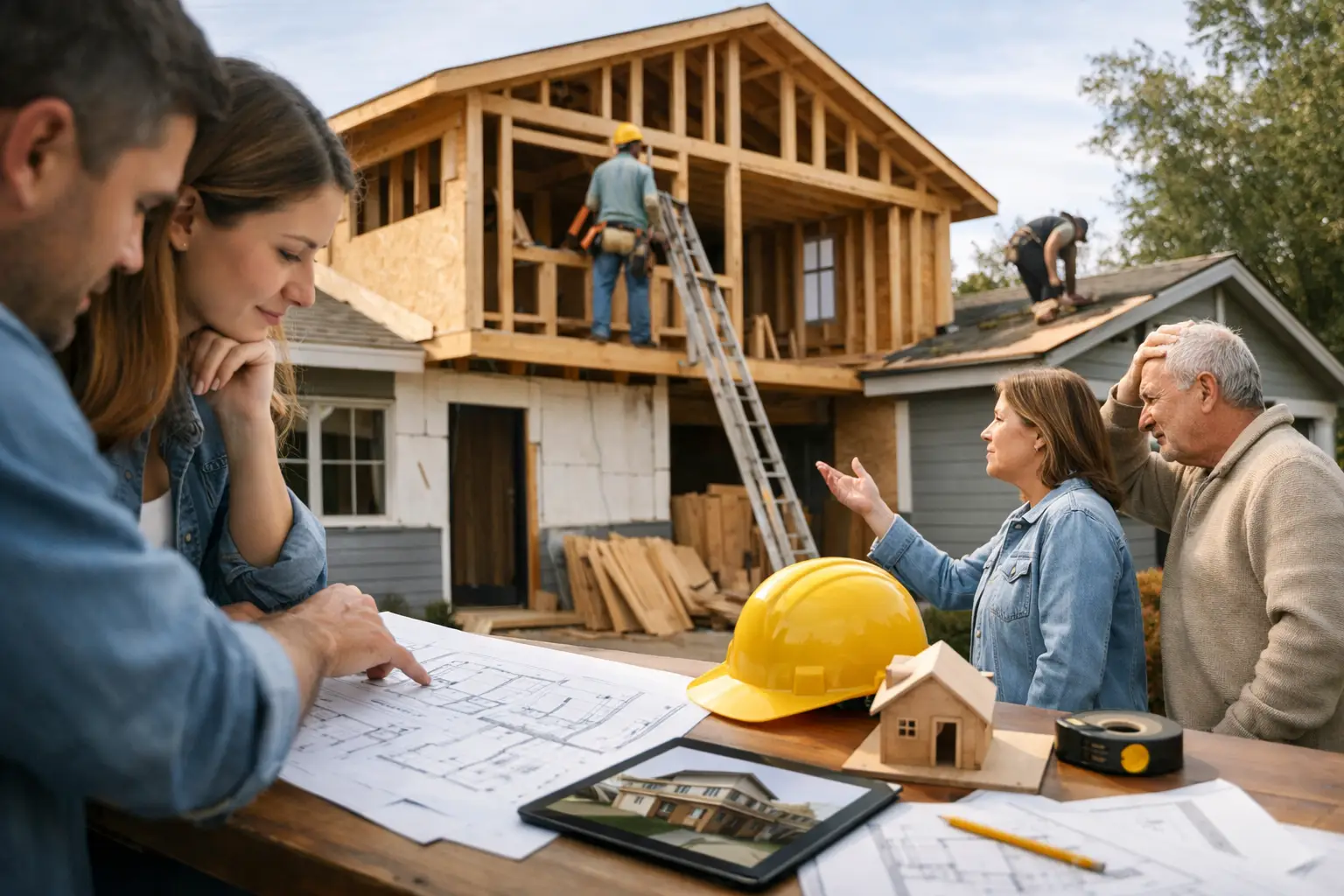
A lot of home additions start with a sketch on paper and a rough budget in someone’s head. That is usually where the trouble begins. The 7 mistakes people make before starting a home addition are not small oversights. They are the kinds of decisions that trigger redesigns, permit delays, budget overruns, and avoidable stress.
If you are planning to add square footage to your home, the smartest move is not swinging a hammer faster. It is getting clear on what the property allows, what the city will require, and what the full project really involves before design gets too far ahead of reality.
Why early planning matters more than most people think
An addition touches far more than the new space itself. It can affect setbacks, lot coverage, structural requirements, energy compliance, drainage, utility loads, and how the existing house ties into current code expectations. Many homeowners assume the hard part starts during construction. In reality, some of the most expensive mistakes happen before plans are even submitted.
That does not mean every project has to become complicated. It does mean that good planning has to happen in the right order.
1. Assuming the lot can handle the addition
One of the most common mistakes is falling in love with a layout before confirming whether the property can legally support it. Homeowners often assume that if there is open yard space, there is room to build. That is not always true.
Zoning rules, setbacks, lot coverage limits, easements, height restrictions, and utility locations can all shape what is possible. In California, local jurisdictions can vary quite a bit, so what worked for a neighbor may not apply to your parcel. Corner lots, narrow lots, and properties with unusual shapes can create extra limitations that are not obvious at first glance.
This is where early site and code review saves time. A realistic design starts with what the property allows, not just what the family wants to add.
2. Building the budget around construction only
Many people price the new square footage and stop there. They may estimate framing, roofing, windows, and finishes, but leave out planning and approval costs that show up long before construction begins.
A home addition budget should account for drafting, structural engineering when needed, permit fees, energy documentation, title or site information, surveys in some cases, and possible plan revisions during review. Depending on the condition of the existing home, there may also be costs tied to electrical upgrades, foundation work, sewer issues, or code-related corrections.
The real issue is not that these costs exist. It is that they are often treated as surprises. A more accurate budget includes pre-construction work from day one, along with contingency for unknowns. That gives homeowners a far better decision-making baseline.
3. Waiting too long to think about permits
Some homeowners treat permits like a final box to check after design is done. That approach can backfire quickly. Permit approval is not a formality. It depends on whether the plans are complete, consistent, and aligned with local requirements.
If the project is designed without permit standards in mind, revisions can stack up. A room layout may need to change for code compliance. Window sizes may need adjustment for light, ventilation, or emergency egress. Structural details may need to be added. Energy requirements may affect glazing, insulation, or mechanical design. Then the project circles back through redesign instead of moving forward.
For homeowners and contractors alike, permit strategy should begin early. It helps shape the plan set correctly from the start and reduces the chance of preventable plan-check comments.
4. Hiring based on price instead of permit-readiness
Low-cost drawings can look like a smart first step, especially when someone is trying to keep the project affordable. But if those drawings are missing critical information or are not prepared for local plan review, the savings tend to disappear.
Permit-ready plans are not just floor plans with dimensions. They need to communicate enough detail for approval and construction. That can include site information, code notes, existing versus proposed conditions, structural coordination, energy compliance coordination, and jurisdiction-specific requirements.
This is one of the 7 mistakes people make before starting a home addition that leads to the most frustration, because the problem often does not show up until the plans are already submitted. At that point, everyone is losing time.
Choosing experienced planning and drafting support usually costs less than reworking incomplete documents after comments come back.
5. Not thinking through how the addition connects to the existing house
Homeowners naturally focus on the new space. The permit reviewer, inspector, and contractor will also be looking at how that space ties into the existing structure. That connection is where many hidden issues live.
Rooflines have to work. Foundation conditions matter. Load paths matter. Existing walls may become structural in a new way once openings are created. Mechanical, electrical, and plumbing systems may need to be extended or upgraded. Sometimes the older part of the house reveals nonconforming work, unpermitted modifications, or field conditions that do not match assumptions.
This does not mean every addition turns into a major overhaul. It means the existing house should be treated as part of the project, not as a fixed backdrop. The more accurately that relationship is understood upfront, the fewer mid-project surprises you are likely to face.
6. Designing for today without considering long-term use
Some additions are driven by immediate needs – a larger primary suite, an extra bedroom, more family space, or room for a relative. Those are valid reasons to build. But if the plan only solves this year’s problem, it may miss larger opportunities or create limitations later.
For example, a homeowner may add space without considering future resale, rental flexibility, aging-in-place needs, or whether the layout will still function if household needs change. In other cases, someone may overbuild for the neighborhood or invest in square footage that does not return much practical value.
There is no single right answer here because it depends on the property, budget, and goals. But it is worth asking a few hard questions early. Is the addition improving the home in a durable way? Will it still make sense five or ten years from now? Is there a simpler footprint that delivers the same benefit with less cost and less permitting friction?
Good planning is not only about getting approval. It is also about making sure the approved design is actually worth building.
7. Starting without a clear process and decision-maker
A home addition can involve homeowners, spouses, contractors, drafters, engineers, and city reviewers. If roles are unclear, the project can stall before it gets traction.
One person may be choosing the layout while another is controlling the budget. A contractor may be asked for pricing before the plans are developed enough to estimate accurately. Plan comments may come back from the city, but no one is clearly responsible for gathering responses. That kind of confusion creates delays that feel mysterious but are usually procedural.
The smoother projects tend to have a simple structure. There is a clear scope, a realistic sequence, and one point of decision-making on the owner side. Everyone knows who is preparing documents, who is reviewing requirements, and who is handling communication during the approval process.
That is part of why homeowners in the Sacramento and Roseville area often look for permit guidance early, not just drafting. The project moves better when someone is helping connect the design, documentation, and local approval path from the beginning.
How to avoid these mistakes before your addition starts
The fix is not overcomplicating the project. It is getting the first steps in the right order. Before investing heavily in plans, confirm what the site can support. Build a budget that includes planning and permit costs, not just construction. Make sure the drawings are being developed for real approval standards. Think carefully about the existing house, the future use of the space, and who will manage key decisions.
This is where experienced guidance matters. JDFales Plans & Permits works with homeowners and contractors to move projects from concept to permit-ready plans with fewer surprises and more clarity. That kind of support does not remove every challenge, but it does help prevent the avoidable ones.
The 7 mistakes people make before starting a home addition usually have the same root cause
Most of these mistakes come from making assumptions too early. Assuming the lot works. Assuming the budget is close enough. Assuming permits will be straightforward. Assuming the plans can be fixed later. Sometimes they can. More often, those assumptions cost time and money.
A home addition is a major investment, and the early phase sets the tone for everything that follows. If you slow down long enough to verify the property, the process, and the documents, you give the project a much better chance of moving forward with fewer corrections and less stress.
The best additions do not start with construction. They start with clarity.